First up:
Allen's Swamp Monkeys (Allenopithecus nigroviridis)

This is one of our two swamps (the boy). They are old world monkeys, closely related to Guenons. Naturally, they live in Congo (in Africa). They are a brown color but their fur has a greenish yellow tint when hit by the sunlight helping them blend into their swampy background. They have slightly webbed feet due to the fact that they have a partially aquatic lifestyle. Very few primates can swim and the keepers were telling me that some of their past swamp monkeys used to swim laps in water features in their exhibits. They are diurnal so they are awake during the day. They are omnivorous eating fruit, leaves, beetles, and worms. However, they are primarily frugivores. They hunt for most of the food on the ground or in water though they are also good climbers. They live in large (multi-male and multi-female) social groups (and little is known about their mating habits) of approximately 40 members. These groups are called tribes, barrels, troops, or cartloads. Weaning takes place at 3 months and they mature at 3 to 5 years. They live into the high teens or early twenties. It's natural predators are snakes, raptors, and humans. Humans hunt them for meat and catch them for pets. They are listed as Near Threatened on the IUCN Red List. Also they get all poofy when they eat because they have cheek pouches.
Look at the sweet faces! (These pictures don't belong to me.)


Black and White Colobus: Mantled Colobus (Colobus guereza)

Fun fact: the name colobus is derived from the greek word that means mutilated due to the fact that their thumbs have been reduced to small stubs that allow them to easily travel along the tops of branched quadrupedally. They are the only old world monkey to have this adaptation.
(These pictures also don't belong to me.)


Third:
Francois Langur (Trachypithecus francoisi)

These diurnal old world monkeys are naturally occurring in southern China surrounding areas- into Vietnam. They are arboreal and live in tropical (and related) areas utilizing forests and cave formations in inclement weather spending most of their time in trees using a form of semi-brachiation (hand swinging, but with support from legs). They are primarily folivorous.
They live in small groups of 3-12 individuals consisting of a male, his female partners and their not yet mature offspring. They reach sexual maturity at 4-5 years. This species tends toward male dispersion.
They are active and noisy species in the wild (as well as the group at the zoo) with much playing, grooming, resting and feeding.
They are listed as endangered due to hunting and habitat fragmentation from human expansion.
Fun fact: I noticed that their cheek patches extend to a very very thin line of white mustache hairs that are only visible from close up and looks adorable.
(More pictures that don't belong to me so that you can actually see more than their shadows.)


White-cheeked Gibbon (Nomascus leucogenys)


Please ignore the mess they made. They had a lot of fun making it. We have two more not pictured because they were hiding behind logs and I did not want to take pictures of gibbon butts.
Gibbons are lesser apes, and as apes they have no tails. They are the smallest of the apes (why they are known as lesser) and are arboreal traversing the trees with brachiation. This is why they have such long arms and very flexible shoulders. It also makes them look very funny when they walk on the ground. In the wild they don't leave the trees very often though. They have natural habitat in the evergreen tropical forests of Southeastern Asia in Laos, Vietnam, and southern China.
They are considered omnivores because they supplement their diets with invertebrates, however they mostly eat ripe fruit and leaves.
They live in family groups of a mated pair and their sexually immature offspring (usually up to four of them at a time). They leave the group at 7-9 years. They have a social hierarchy with the female adult dominant, followed by female offspring, then male offspring, and finally the adult male.
Their vocalizations include a unique sort of calling in which the male and female "sing" together in alternating sequences while performing very exciting acrobatics. It is very high pitched and we have several pairs of ear muff ear plugs to wear when they get going.
Something cool about this species is the coloring. It is sexually dimorphic for adults with the beige females and black males. However, all newborns are born beige so they can blend in with they mother's abdomen. At about 1 1/2 years they have turned black. At this time they've started weaning and spend more time with their fathers. At sexual maturity, females turn colors again back to the beige coat.
Fun fact: Like the langurs, the black furred gibbons' white cheek patches connect to a thin white mustache that is only visible from close up. It is also adorable.
(More pictures I don't own!)
.568.jpg)

Last but not least:
Ring-tailed Lemur (Lemur catta)
Lemur Cuddle Puddle! This is legit how they take their naps. It's adorable.
Like all lemurs, they are prosimians (Like the gibbons, they are also not monkeys.) from Madagascar. However they are unique with scent glands on the inside the upper arms as well as those at the base of the tail and chest. The males have calloused spurs and scent glands on their wrists that they use to gouge tree branches while they scent mark. They also use their arm glands to scent mark their tail and wave it at a competitor.
They are also omnivorous supplementing their primarily fruit, leaf, and plant based diet with occasional insects and small mammals. When they eat they tip their heads way back to make sure nothing falls out of their mouths like fruit juice.
Unlike other lemur species, they use the ground for travel as well as trees. Other species are often exclusively or almost exclusively arboreal. These lemurs can tolerate less forested habitat. They are diurnal and often perform a behavior called sunning where they sit upright and rest their front legs outstretched on their back legs while sitting in a patch of sun.
They live in social groups anywhere from 3 to 25 individuals. The groups are matriarchal with females dominant and males disperse at sexual maturity. Their hands are not as dexterous as other primates so they utilize comb shaped bottom teeth to groom each other. They are very vocal with clicking location calls and they often mew and sounds exactly like cats.They are listed as Near Threatened due to habitat degradation from annual burning practices to create pasture for livestock, human exploitation for food and pets, and predation by fossas and civets (introduced) as well as raptors and snakes.
(Some super adorable pictures that I don't own.)

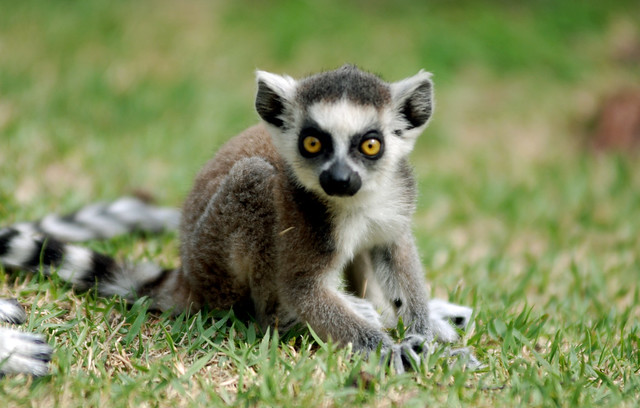 Baby! Because we have two!
Also this is what they look like when they sun.

